I'm writing an article about FOSS and Linux music players. What was the very first music player application for Linux? Was there ever a time when the players didn't support proprietary formats like MP3s?
Asked
Active
Viewed 1,108 times
5


-
2Note that Linux predates the MP3 format. – Stéphane Chazelas May 09 '13 at 15:25
-
3`cat soundfile.au > /dev/audio` ? (And the MP3 standard was released in 1993. SLS, one of the earliest Linux distros, was 1992. So clearly it didn't have MP3 support) – derobert May 09 '13 at 15:34
-
1and you couldn't really play MP3s on PC hardware before the 486DX66. (I could play short MP3s on my 486DX33 with mpg123 but only via using big memory buffers and start decoding long before playing). – Stéphane Chazelas May 09 '13 at 15:34
-
I remember the performance toll SoundApp on my old Mac used to have. MP3 was a heavyweight codec, at the time it came out! – derobert May 09 '13 at 15:42
-
1And in early Linux days, getting X to run was how we had fun. Music? that's what cd players were for. – msw May 09 '13 at 18:16
-
if your distro *included* X. My first Slackware archive had `startx` but no window servers! – MattDMo May 09 '13 at 18:34
2 Answers
4
The first application that I ever came across that could play .wav or .mp3 files was sox. It was available on Solaris 2.5.1 when I first found out about it. I believe it predates that as well.
I was using sox in 1997.
The wikipedia page has it pegged at 1991. Incidentally the app is named SoX, for Sound Exchange.
excerpt from history section of wikipeidia page
SoX was created in July 1991 by Lance Norskog and posted to the Usenet group alt.sources as Aural eXchange: Sound sample translator. With the second release (in November the same year) it was renamed Sound Exchange. Norskog continued to maintain and release SoX via Usenet, FTP, and then the web until early 1995, at which time SoX was at version 11 (gamma). In May 1996, Chris Bagwell started to maintain and release updated versions of SoX, starting with version sox-11gamma-cb. In September 2000, Bagwell registered the project at SourceForge with project name "sox". The registration was announced on the 4 September 2000[citation needed] and SoX 12.17 was released on 7 September 2000. Throughout its history SoX has had many contributing authors; Guido van Rossum, best known as creator of the Python programming language, was a significant contributor in SoX's early days
I should clarify on Solaris I was using sox to play .wav and .aiff files, not mp3s. It wasn't until years later that I used sox to play .mp3 files on some version of Red Hat. I must be getting old, but I seem to remember Red Hat v8.0 or v9.0, it's foggy now.
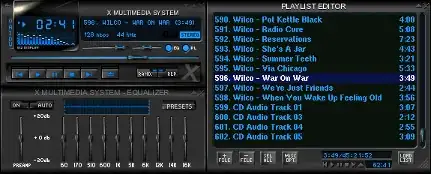
XMMS
Another application that I remember using was called XMMS, circa 1997. This was very ahead of it's time. Was light weight, skinnable, and included plugins.
screenshot
MP3 Copyright Issues
For most people using Linux with MP3 support it was something that you really wanted to do. You'd typically have to jump through several hoops to get it working.
For example: Why Linux don’t support mp3 and selected wifi cards out of the box?
It was only in the last few years that you could legally obtain a license for playback from Fluendo.
As @derobert indicated in a comment, we believe the patents might be expired at this time. Seems to may be the case looking at the wikipedia page for the MP3 format. But I'm no lawyer.
excerpt from MP3 wikipedia page
The initial near-complete MPEG-1 standard (parts 1, 2 and 3) was publicly available on 6 December 1991 as ISO CD 11172.[52][53] In most countries, patents cannot be filed after prior art has been made public, and patents expire 20 years after the initial filing date, which can be up to 12 months later for filings in other countries. As a result, patents required to implement MP3 expired in most countries by December 2012, 21 years after the publication of ISO CD 11172.
An exception are the United States, where patents filed prior to 8 June 1995 expire 17 years after the publication date of the patent, and a loophole known as submarine patents made it possible to extend the effective lifetime of a patent through application extensions. The various MP3-related patents expire on dates ranging from 2007 to 2017 in the U.S.[54] Patents filed for anything disclosed in ISO CD 11172 a year or more after its publication are questionable; if only the known MP3 patents filed by December 1992 are considered, then MP3 decoding may be patent-free in the US by September 2015 when U.S. Patent 5,812,672 expires which had a PCT filing in Oct 1992.

slm
- 363,520
- 117
- 767
- 871
-
According to [Wikipedia](http://en.wikipedia.org/wiki/SoX), SoX was first released in 1991. – Stéphane Chazelas May 09 '13 at 15:36
-
I'm pretty sure the MP3 patents have expired now. Note that, for example, `lame` has been in Debian main for a while now, and players for even longer. – derobert May 09 '13 at 15:39
-
-
@derobert: Depends: http://www.osnews.com/story/24954/US_Patent_Expiration_for_MP3_MPEG-2_H_264/ , first patent expired 2007, last expire 2017. – Runium May 09 '13 at 15:43
-
@slm, Fluendo paid for MP3 licenses to be able to provide MP3 codecs legally without cost. They aren't "free". – vonbrand May 09 '13 at 15:48
-
@derobert, I have seen several "music players" in Red Hat/Fedora, but all had MP3 completely disabled for legal reasons. – vonbrand May 09 '13 at 15:49
-
@vonbrand, strange, go to this URL and it shows them as free to add to your shopping cart: http://www.fluendo.com/shop/product/fluendo-mp3-decoder/ – slm May 09 '13 at 15:55
-
@slm: and as the page says: *"Fluendo has paid the license of Fraunhofer and Thomson to be able to distribute a binary MP3 decoder."* – Runium May 09 '13 at 16:02
-
@Sukminder: All I was saying was that it was free to you. Don't think I implied that it was free free. – slm May 09 '13 at 16:03
-
+1 for xmms. Nowadays I *still* catch myself wishing iTunes was as easy and straight-forward to use, yet as extremely extensible as xmms was/is. – MattDMo May 09 '13 at 18:37
-
`xmms` is the new name for what was `x11amp` before which was mostly a clone of `winamp` so I wouldn't say it was _ahead of its time_. – Stéphane Chazelas May 09 '13 at 19:28
-
@StephaneChazelas: point taken. Compared to the other choices on Linux it was 8-). – slm May 09 '13 at 19:44
2
There probably was no "first for Linux", the Linux kernel has been supplemented with userland programs collected from all over the place from the very start, the overwhelming majority of it originally developed for some propietary Unix system or one of the BSDs, and even in some case ported over from other operating systems. Much of this happened in parallel by separate groups working on (proto) distributions. I'm certain this happened (almost) simultaneously in different ways once some sort of audio driver came to be.

vonbrand
- 18,156
- 2
- 37
- 59
-
Thanks ! However, was there MP3 support in most distros at that time ? I am trying to gauge the impact of say Banshee or Rhythmbox and how much they helped Linux users. Did they 'scratch an itch' so to speak ? – Tushar May 09 '13 at 15:10
-
@TusharB, there can't be free legal MP3 support as the format is patented. There has always been support for open audio formats (but those mostly came later), for playing music CDs, and also hacks to add support for MP3 (of more than dubious legality) for a long time. – vonbrand May 09 '13 at 15:15
-
Oh OK. But I presume these were far from straightforward ? In my article I am suggesting that listening to music was not all that convenient till Rhythmbox, Banshee etc. came along ; would that be a justified statement, in your opinion ? – Tushar May 09 '13 at 15:22
-
Not legitimately due to copyright laws around the MP3 format: http://www.cyberciti.biz/tips/why-linux-dont-support-mp3-and-selected-wifi-cards-out-of-the-box.html – slm May 09 '13 at 15:32
-
It's only in the last 5 years or so that you could get a legitimate license for playback from Fluendo: http://www.fluendo.com/shop/product/fluendo-mp3-decoder/ – slm May 09 '13 at 15:34
-
1@TusharB No, that'd be far from true. [XMMS](http://en.wikipedia.org/wiki/XMMS) (X11Amp at the time) was 1997, for example. – derobert May 09 '13 at 15:36
-
Ah, `xmms`, so ahead of it's time, I used to use that one too. Great little app. Was completely customizable, had plugins, and was skinable. – slm May 09 '13 at 15:39
-
Thanks for all the inputs ! Guess I'll have to make some changes to my article. – Tushar May 09 '13 at 16:12