The patch script is accessible here in it's own GitHub repo, titled: powerline-patcher.
An experiment
I first started by downloading the above patching script.
$ git clone https://github.com/Lokaltog/powerline-fontpatcher.git
I then selected a sample .ttf file to test out your question.
$ ls -lr | grep ttf
-rw-r--r--. 1 saml saml 242700 Jul  2 20:29 LucidaTypewriterRegular.ttf
Running the font patching script produced the following output:
$ scripts/powerline-fontpatcher LucidaTypewriterRegular.ttf
The glyph named fraction is mapped to U+2215.
But its name indicates it should be mapped to U+2044.
The glyph named periodcentered is mapped to U+2219.
But its name indicates it should be mapped to U+00B7.
The glyph named macron is mapped to U+02C9.
But its name indicates it should be mapped to U+00AF.
The glyph named stigma is mapped to U+03DA.
But its name indicates it should be mapped to U+03DB.
The glyph named digamma is mapped to U+03DC.
But its name indicates it should be mapped to U+03DD.
The glyph named koppa is mapped to U+03DE.
But its name indicates it should be mapped to U+03DF.
The glyph named sampi is mapped to U+03E0.
But its name indicates it should be mapped to U+03E1.
The glyph named fraction1 is mapped to U+2044.
But its name indicates it should be mapped to U+2215.
With the resulting file:
$ ls -lr | grep ttf
-rw-r--r--. 1 saml saml 242700 Jul  2 20:29 LucidaTypewriterRegular.ttf
-rw-rw-r--. 1 saml saml 242576 Jul  2 21:02 Lucida Sans Typewriter Regular for Powerline.ttf
If I run it 2 more times on the resulting files, I get the same output each time as above, resulting in files looking like this:
$ ls -ltr | grep ttf
-rw-r--r--. 1 saml saml 242700 Jul  2 20:29 LucidaTypewriterRegular.ttf
-rw-rw-r--. 1 saml saml 242576 Jul  2 21:02 Lucida Sans Typewriter Regular for Powerline.ttf
-rw-rw-r--. 1 saml saml 242780 Jul  2 21:04 Lucida Sans Typewriter Regular for Powerline for Powerline.ttf
-rw-rw-r--. 1 saml saml 242984 Jul  2 21:07 Lucida Sans Typewriter Regular for Powerline for Powerline for Powerline.ttf
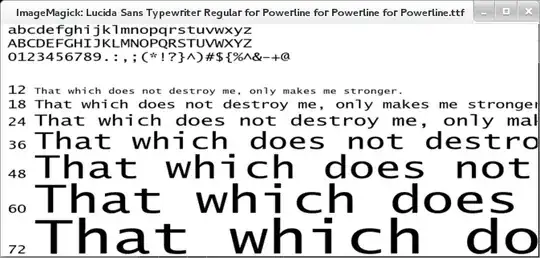
All these resulting .ttf files appear valid when I attempt to open them using ImageMagick's display command:
$ display Lucida Sans Typewriter Regular for Powerline for Powerline for Powerline.ttf
Takeaways
So it would seem you can reprocess font files using the patching script, it's unclear to me why the size keeps growing as you perform this operation, so I would keep the originals handy just in case you encounter problems.
If it was me, I would probably ditch the previously patched files and regenerate them just to be on the safe side.
References

