2

I'm about to buy a new laptop which has a SSHD. It stands for Solid State Hybrid Drive, which means it has a big, regular HDD with a small, usually 8GB SSD to cache frequently accessed files.

Now since I'm a Linux user and I want pure SSD speed, so I thought it would be awesome if I could detach the SSD from the HDD and use it completely separate. I've googled for this topic, but could not find anything useful. According to Wikipedia there is a standard to communicate with the drives separately, but I may have misunderstood.

Does anyone know anything about this topic?

Gilles 'SO- stop being evil'
  • 807,993
  • 194
  • 1,674
  • 2,175
Semmu
  • 33
  • 1
  • 3
  • The tag sshd shouldn't be used here, I understand the difference you're portraying w/ SSHD vs. SSD but `sshd` is the name of the SSH daemon, and that's a more on topic item on this site. – slm Feb 01 '14 at 23:54
  • 1
    My sense (and a quick Google search) is that those hybrid drives with a SSD cache are a black box and there's no way to directly access the SSD; it would be like trying to directly access a CPU cache. – samiam Feb 02 '14 at 00:04
  • What wikipedia article are you talking of? Please add a link in your question. – michas Feb 02 '14 at 01:07
  • The one you linked in your answer, so you found it :) – Semmu Feb 08 '14 at 20:30

2 Answers2

2

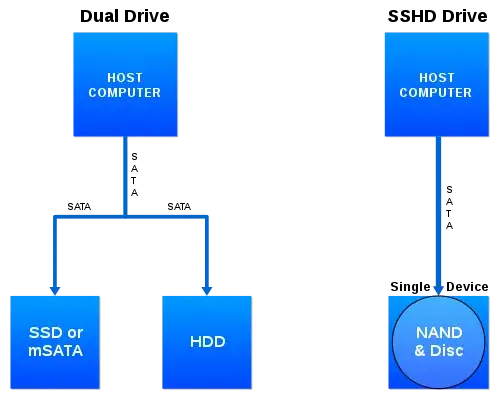
According to http://en.wikipedia.org/wiki/Hybrid_drive there are two different types of hybrid disk "dual drives" with separate manageable disks and integrated SSHDs which cannot be used separately.

michas
  • 21,190
  • 4
  • 63
  • 93
  • Likely the one in the laptop is the second type. I'm sad to hear that it can't be used separately. – Semmu Feb 02 '14 at 18:49
2

The wikipedia article goes on to say that in some cases it is possible to manage the SSHD cache from the host:

SSHD products operate in two primary modes:

Self-optimized mode In this mode of operation, the SSHD works independently from the host operating system or host device drives to make all decisions related to identifying data that will be stored in NAND flash memory. This mode results in a storage product that appears and operates to a host system exactly as a traditional hard drive would.

Host-optimized mode (or host-pinning mode) In this mode of operation, the SSHD enables an extended set of SATA commands defined in the Hybrid Information feature of the Serial ATA International Organization standards for the SATA interface. Using this feature, decisions about which data elements are placed in the NAND flash memory come from the host operating system, device drivers, host software or a combination of these host level components.

A little bit of googling tells me that patches to make use of the hybrid information feature from SerialATA Revision 3.2 section 13.20 have been submitted for review, and that host pinning support may be merged in at the earliest to the 3.19 release.

cjac
  • 386
  • 2
  • 8